A variety of latent Markov models, including hidden Markov models (HMMs), hidden semi-Markov models (HSMMs), state-space models (SSMs) and continuous-time variants can be formulated and fitted within the same framework by directly maximising the likelihood function calculated using the so-called forward algorithm. Applied researchers often need custom models that standard software does not easily support. Writing tailored R code offers flexibility but suffers from slow estimation speeds. LaMa solves these issues by providing easy-to-use building-blocks for common tasks, which can be combined into custom models in a Lego-type approach, offering very fast estimation speeds. LaMa now also allows for automatic differentiation with the RTMB package, which drastically increases speed and accuracy even more and allows for rich random effects structures.
Installation
You can install the released package version from CRAN with:
install.packages("LaMa")or the development version from Github:
remotes::install_github("janolefi/LaMa")Package documentation
To aid in building fully custom likelihood functions, this package contains several vignettes that demonstrate how to simulate data from and estimate a wide range of models using the functions included in this package.
HMMs, from simple to complex:
Other latent Markov model classes:
Introductory example: Homogeneous HMM
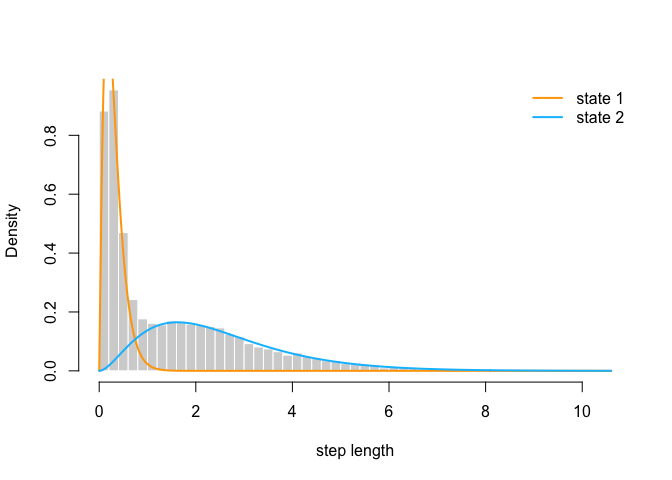
We analyse the trex data set contained in the package. It contains hourly step lengths of a Tyrannosaurus rex, living 66 million years ago. To these data, we fit a simple 2-state HMM with state-dependent gamma distributions for the step lengths.
library(LaMa)
#> Loading required package: RTMB

head(trex, 3)
#>   tod      step     angle state
#> 1   9 0.3252437        NA     1
#> 2  10 0.2458265  2.234562     1
#> 3  11 0.2173252 -2.262418     1
We start by defining the negative log-likelihood function. This is made really convenient by the functions tpm() which computes the transition probability matrix via the multinomial logit link, stationary() which computes the stationary distribution of the Markov chain and forward() which calculates the log-likelihood via the forward algorithm.
nll = function(par, step){
  # parameter transformations for unconstrained optimisation
  Gamma = tpm(par[1:2]) # rowwise softmax
  delta = stationary(Gamma) # stationary distribution
  mu = exp(par[3:4]) # state-dependent means
  sigma = exp(par[5:6]) # state-dependent sds
  # calculating all state-dependent probabilities
  allprobs = matrix(1, length(step), 2)
  ind = which(!is.na(step))
  for(j in 1:2) allprobs[ind,j] = dgamma2(step[ind], mu[j], sigma[j])
  # simple forward algorithm to calculate log-likelihood
  -forward(delta, Gamma, allprobs)
}
To fit the model, we define the intial parameter vector and numerically optimise the above function using nlm():
par = c(-2,-2,             # initial tpm params (logit-scale)
        log(c(0.3, 2.5)),  # initial means for step length (log-transformed)
        log(c(0.2, 1.5)))  # initial sds for step length (log-transformed)

system.time(
  mod <- nlm(nll, par, step = trex$step)
)
#>    user  system elapsed
#>   0.354   0.011   0.367
Really fast for 10.000 data points!
After tranforming the working (unconstrained) parameters to natural parameters using tpm() and stationary(), we can visualise the results:
# transform parameters to working
(Gamma = tpm(mod$estimate[1:2]))
#>           S1        S2
#> S1 0.8269546 0.1730454
#> S2 0.1608470 0.8391530
(delta = stationary(Gamma)) # stationary HMM
#>       S1       S2
#> 0.481733 0.518267
(mu = exp(mod$estimate[3:4]))
#> [1] 0.3034926 2.5057054
(sigma = exp(mod$estimate[5:6]))
#> [1] 0.2015258 1.4908153

hist(trex$step, prob = TRUE, bor = "white", breaks = 40, main = "", xlab = "Step length")
curve(delta[1] * dgamma2(x, mu[1], sigma[1]), add = TRUE, lwd = 2, col = "orange", n=500)
curve(delta[2] * dgamma2(x, mu[2], sigma[2]), add = TRUE, lwd = 2, col = "deepskyblue", n=500)
legend("topright", col = c("orange", "deepskyblue"), lwd = 2, bty = "n", legend = c("state 1", "state 2"))